

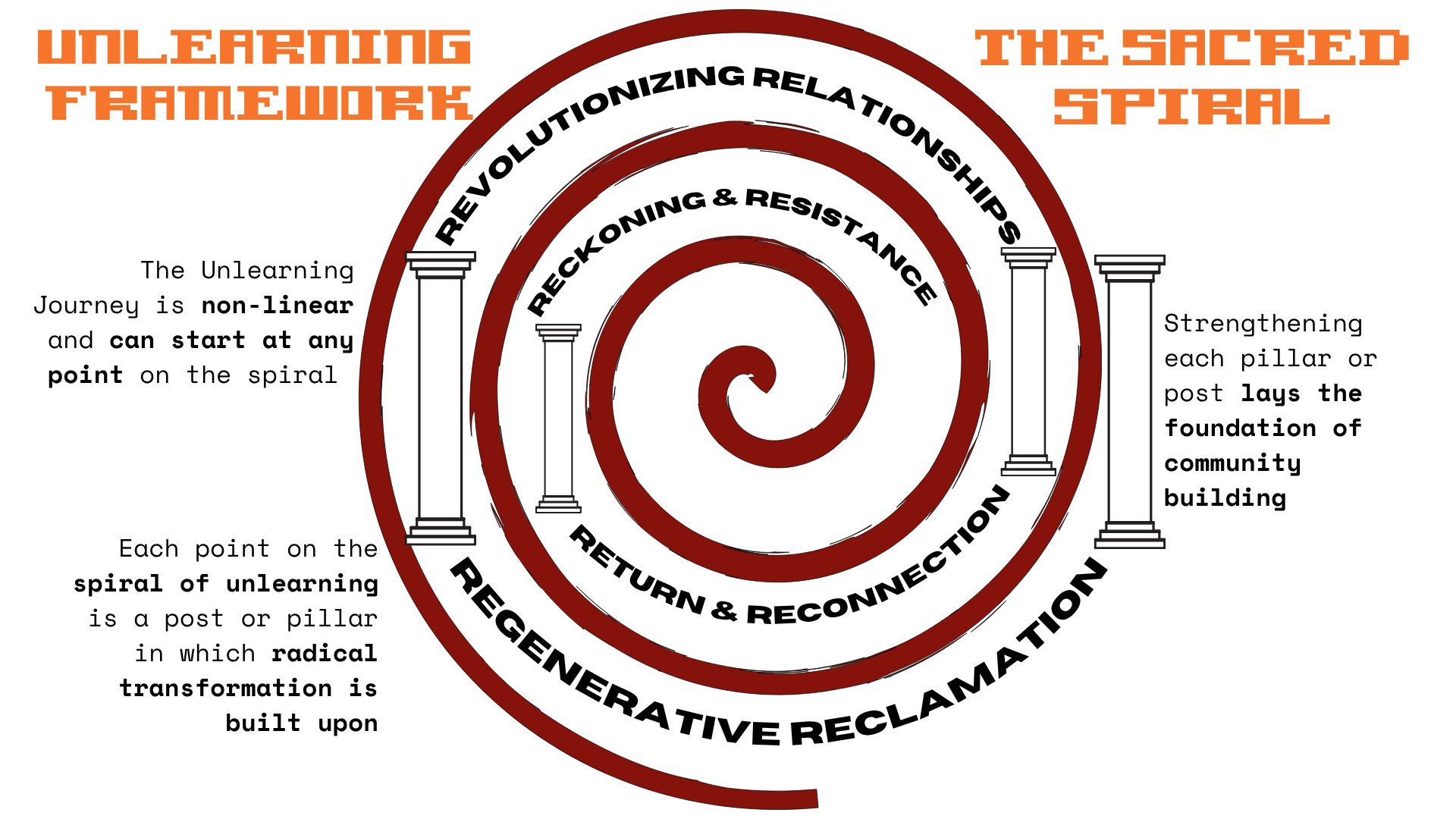

UNLEARNING FRAMEWORk: CORE TOPICS

Restorative
JusticE
REVOLUTIONIZING RELATIONSHIPS
Critical Positionality
Conscious Relationship Building
Communication Styles (Levels of Listening)
Navigating conflict (Clarify, Connect, Choose)
Holding boundaries for Accountability
Unlearning Practices
Transformative Justice
RECKONING & RESISTANCE
Pyramid of Hate
4 I’s of Oppression
Intersectionality
Community Cultural Wealth
RETURN & RECONNECTION
Forms of Colonialism, Colonization & Decolonization
Integrating Indigenous knowledge systems & practices
hEALING
Justice
REGENERATIVE RECLAMATION
Roles & tools of cycle breakers
From Trauma-Informed Care to Healing-centered Engagement
Historical & Intergenerational Trauma + Lineage Gifts/Power
Activating and cultivating Liberatory Communities of Practice

foundational pedagogy:
PEEP THE TECHNIQUE

Liberatory Cultural and Political Education

Unlearning-Learning Approach
“For Us, By Us”
A collaboration and co-curation of curriculum with students to address what they are directly experiencing and navigating in themselves, their relationships, and our society
Drawing from abolitionist frameworks, students co-design strategic plans to apply what they are unlearning-learning with their communities, and integrate this knowledge towards a vision of collective liberation.
“Each One, Teach One”
“This African proverb originated in this era of enslavement. When one enslaved person acquired knowledge or skills including learning to read or write, it was a shared understanding and commitment to teach another” (BC Black History Awareness Society). Sharing the power of learning was seen as a collective responsibility, even in the face of lethal consequences.
Learning involves a responsibility to share the fruits of the unlearning-learning process with others to support their transformation towards healing and liberation.

Self-Determination: Learning that upholds the agency of students to design and decide what they want to learn, and how they will apply what they learn with peer & intergenerational guidance and support.
Sovereignty: Learning that incorporates knowledge students already hold from community cultural wealth (Yosso, 2005), and addresses the power dynamics of systemic oppression we are all navigating.
The goal of Liberatory Cultural and Political Education in our work is to transform the ways we learn about ourselves, each other, and the world through a dialectical unlearning-learning process in each class we offer.
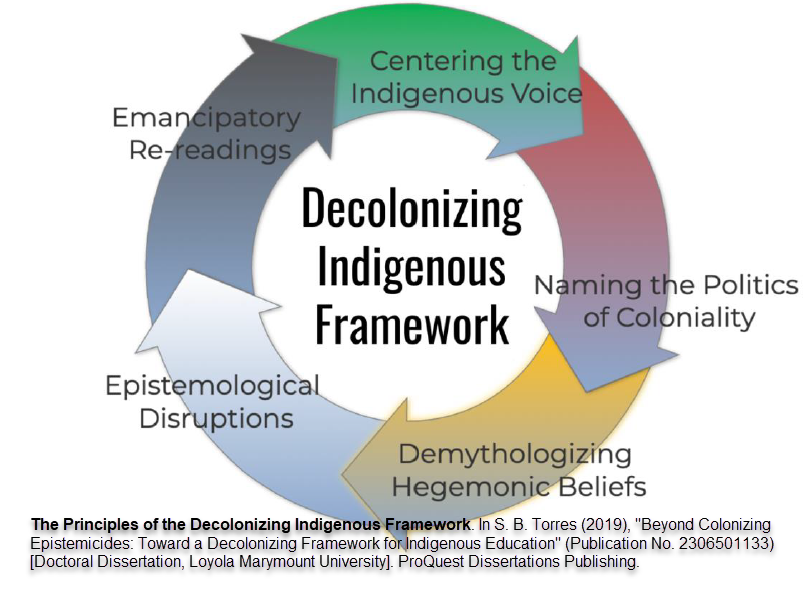
We utilize a decolonizing model to education which centers Indigenous pedagogies and epistemologies as our foundational pedagogies or teaching styles.